Now these prices are for full size kegs and vary depending on where one buys the keg, If I show a price range assume the lower price is the price in Chico and the high price is the price in Davis. Note these prices do not include tax or keg shell deposit and they are not completely accurate! Call Aggie Liquor in Davis 530-753-4441 or Star Liquor in Chico 530-891-4842 for up to date pricing.
45-55 Natural Ice/Keystone Light (Disgusting)
55-65 Miller Genuine Draft (Utter Crap)
60-70 Pabst Blue Ribbon (King of the Shitty Beers)
80-90 Coors and Coors Light (Standard Beer Pong Grade Beer)
90-120 Bud, Bud Light (Bud Blows Goats for Quarters)
80-120 Butte Creek Brewing Company's Beers (this is a small brewery in Chico, some of their beers are great some are complete crap, also they are inconsistent from batch to batch which can result in one getting a crappy keg.
99-130 Sierra Nevada (Really Good Beer) Styles (Pale Ale, Draught Style Pale Ale, Brown Ale, IPA, Stout, Porter, Early Spring Beer, Anniversary Ale, SummerFest, Celebration Ale, Wheat, Crystal Wheat, Pale Bock, and several more)
115-150 Sierra Nevada Harvest Ale and Big Foot (Both Hardcore Beers, Bigfoot more so)
150-200 Any of the Red Hook Brewing Company's Products, Any of the Pyramid Brewing Company Beers, Widmer Hefeweizen, Anchor Steam, Just about any US Microbrew, Guinness*, Heineken*, Spaten*, Bass Pale Ale*, Becks* Chimey* (I would suspect Chimey to be even more expensive then what I have listed)
Now would be a good time to talk about beer keg sizes, Kegs come in four sizes, which are referred to by two different names just to keep things simple. Firstly you have the pony kegs which refers to either a 5.23 gallon/19.80 liter keg or a 7.75 gallon/30 liter keg. Then there is the full size keg or half barrel keg as it is sometimes called. This is referring to a 15.5 Gallon (59.42 Liter) keg. *With the exception of full size European Kegs which are smaller then a full size US keg
Here is a break Down Of Keg Sizes
1/6 Barrel 5.23 gallon/19.80 liter which provides 53 12oz servings 39 pints or 39 plus full red cups
1/4 Barrel 7.75 gallon/30 liter which provides 82 12oz servings or 60 Pint servings ie. 60 full red cups
1/2 Barrel (American full size keg) 15.5 gallon/59.42 which provides 165 12oz servings or 119 pints or 119 full red cups
*European Full Size Keg 13.21 gallon/50 liter which provides 140 12oz servings or 100 pints or 100 full red cups
All the beers I marked with and star"*" come in a full size European Keg for the price displayed. Because this keg is smaller (by 2.3 gallons) then its full size American counterpart it makes the European beer more expensive per unit volume. Keep in mind some of the best beers in the world come in European kegs, such as Guinness Draught and Spaten. I have had both of these kegs (Spaten and Guinness Draught) before and I can promise they are worth the their cost if you are really looking for a good beer.
If you have any question message me or leave a comment for this post.
Tuesday, January 29, 2008
Common Questions About Getting a Keg

Monday, January 28, 2008
Refilling a Keg
I am often asked how to one goes about refilling a beer keg. This is an interesting question because the average person really is not interest in refilling a keg. They are interested rather in taking a empty keg or keg shell they have in their possession and converting it into a full keg of beer. There are a number of methods for turning an empty keg into a full one. The first being you can prey to the supreme being of your choice to turn the air inside the keg to beer. For this option I recommend praying to Ninkasi, the Sumerian goddess of beer. Alternitivly you could pray to Ronald Reagan or the Judeo-Christian god among others. Statistically this method is ineffective although I don't have the numbers to back up that statement.
The second option is by far the easiest and most effective, this involves taking one's empty keg shell to their local liquor store and exchanging it for a full keg of beer. Might I recommend any of the fine beers produced by Sierra Nevada as a excellent choice to exchange your empty shell for. A couple things to keep in mind about this option; if you are in California you generally need to have the keg identification sticker on the keg to exchange it. This hasn't tended to be an issue here in Davis, but in Chico you definitely needed the sticker. Also different brewers charge different amounts for keg shell deposits. For example Sierra Nevada charges just twenty five dollars where Widmer Brothers Brewing charges forty to forty five dollars and Pabst charges thirty five. The keg your exchanging your empty shell for might have a higher shell deposit then the shell you are exchanging and you will need to make up the difference.
The last option is by far the hardest and most time consuming option, this involves opening up the keg cleaning out the old stale beer, sterilizing and refilling with home brewed beer. I could spend a whole post talking about how to do this. Basically you will need to brew up about fifteen gallons of beer and then put it in your keg. I am leave a number of steps out. This is an enormous amount of work unless you know exactly what you are doing in which case it is still a lot of manual labor.
If you still want to open your keg shell up for some other reason take a look at the following web site on how to open a sankey type keg. Let me be the first to say this can be a very dangerous and is most often a messy job in which the residual beer sprays all over the place unless you cover the tap with a towel. Even then old warm crummy beer still gets all over.
Why would one want to open a keg up? My best guess is to us it for home brewing or to make the most bad ass batch of jungle juice ever, which I have done and will explain how to do it in a later post.
To summerize again how to refill an empty keg shell you can:
A. Pray to the supreme being of your choice (Ninkasi or Ronald Reagan.)
B. Exchange the empty keg shell for a new keg of beer at your local liquor store.
C. Open, clean, sterilize and fill the empty keg shell with your own home brew.
D. Make a awesome keg stool/seat out of your empty keg shell.
Let me emphasize choice B as it is the only choice for the majority of the population, choice C is just to much work. Even if you have made a batch of home brew before that was likely only five gallons or so this would be fifteen plus gallons. I am not trying to discourage any one, I only want to make you aware of the work involved and how much easier it is to just exchange the empty keg shell for a new full keg of beer. Best of luck to all on your kegging adventures.
Saturday, January 12, 2008
The Kegerator
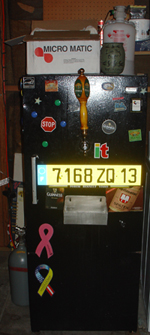
Not a long post today, just some pictures of the current state of the kegerator. I just repainted the door of the kegerator a couple of days ago. Keep in mind that the amount of beer kept on hand is not the same as the amount of consumed over a given period of time (ie were not a bunch of boozers.) Especially when it comes to Coors and Coors Light. Those are both reserved for beer pong games exclusively. For those of you out there who aren't fans of drinking games, such as beer pong, keep in mind we always keep plenty of good beer in the kegerator for the most important drinking game of all - drinking!

 The keg tap and eggs! You can see that this is a Keg of Widmer Hefeweizen
Thursday, January 10, 2008
Keg Seats
 Over the last few years I have collected, or rather acquired a number of keg shells. Mainly off of craigslist, which is a good place to look for all sorts of brewing equipment. A keg shell is simply the metal part of a beer keg. When I refer to a keg shell I mean a empty keg of beer which has often had the tap coupler removed. This allow different solutions to be placed inside the keg. For instance after cleaning out the keg. Which is done by adding water and bleach and a foot long food grade stainless steal chain.
A batch of beer could now be fermented inside of the keg. A full size keg holds three times the volume of the average home brew fermenter and the metal conducts heat better then plastic. If one had access to a swimming pool during the right times of the year. For instance winter, a keg filled with lager to be fermented could be placed on the steps on the pool so as only the top fifteen or so cm was exposed and then cap the top off with a rubber bung and a air lock. The pool water would keep the yeast the proper temperature for a strong healthy fermentation. An open keg shell could also be used as a boiling vessel for a fractional distillation apparatus to used to produce essential oils, vinegar or possible ethanol for uses as fuel (this would of course only be done once the proper permits were obtained from the ATF and the ethanol was only used for fuel.) I will post later on methods for producing fuel ethanol.
Needless to say there are a lot of uses for a keg shell besides just holding draft beer. As I mentioned before I have a few keg shells not including the full keg of Widmer Hefeweizen I currently have in my kegerator, it is such a great beer. When you can get it on tap at your local bar, restaurant or pub, it's awesome.
Currently in my garage I have three empty keg shells. All on them happen to be Sierra Nevada keg shells also. I have had then in my garage for about two or three months. What I figured out was that if you flip the shell over you can sit in a mildly comfortable fashion on the bottom of the keg. Although one's butt and legs get rather sore quickly, so maybe not so comfortable. In our garage we currently have a shortage of seating. We have two lawn chairs and the four chairs from inside at the dinner table. When we have a party there is not enough room for people to sit. Our garage is not big enough for us to seat everyone, but a few more seats would help. I flipped over all the keg shells and people didn't really sit on them, they just got in the way.
Early last month I had this idea, do you see where I am going with this. I tend to take a long time to get to the  point. The kegs needed a soft seat to go on top of them. My idea was to take a piece of plywood and cut it in a circle the diameter of the keg. Then take a two by four and cut a hole which would fit over the opening on a keg shell. See the pictures for an example of what the opening on a keg shell looks like. The two by four would be fixed to one side of the round plywood and then a few centimeters of foam would be placed on the other side of the plywood to be held in place by a piece of fabric.
While up at my grandparents home outside of Reno, Nevada I had access to my grandfather's shop, which contains the tools needed to produce t he seat. I took a keg shell to their house for this very purpose. Once he understood what I was trying to build we managed to knock the wooden portion of a seat out in under an hour. Then next two only took forty minutes to make both.
The next aspect of the seat construction required I travel to Carson City, Nevada which is not to far from their home, to pick up the necessary foam and fabric. We got the supplies at this hole in the wall fabric store. We settled on firm two inch foam and black marine upholstery leather (or rather fake leather that is.) Stretching the leather over the foam and stapling it to the back side of the  wood seats went really fast. We managed to finish all three of the seats in under an hour.
The only changes from my original design in my head is we used three two by fours to hold the seat in place on top of the keg. as opposed to the single two by four with a hole in it. I don't feel that it makes any difference either way. All the wood used for the seats was scrap wood to cutting down on cost. My final cost for each seat was ten dollars, basically for foam and fabric. Take a look at the pictures, I think the seats turned out really nice and are very comfortable. I'm really looking forward to our next party/gathering to get some feed back on these seats which essentially turn a keg shell into a comfy stool!